
How our resins work
The material science behind our resins: how the families differ, how they are characterised, and which products come out of each one. A variety of resins with different properties and application areas are available for testing and evaluation.
Resin families
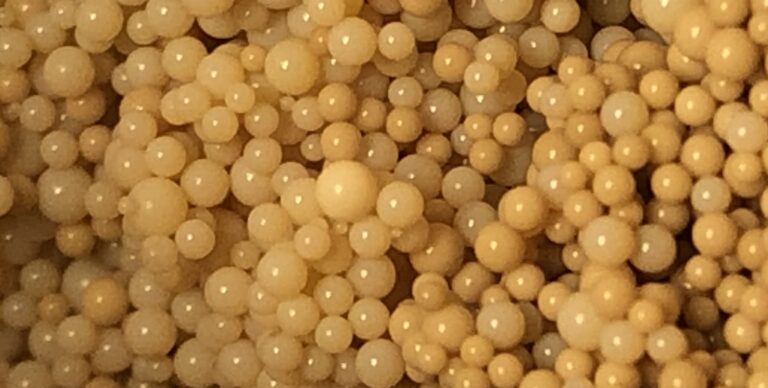
Large beads
Optimised for generic and water-based applications, in the 200 to 1000 um range.
Rigid resins
Powerful for non-aqueous and aqueous solutions, with high material rigidity.

SPE products
Solid phase extraction materials for sample preparation and clean-up.

Scavengers
Scavengers and resin bound reagents for removing or delivering reactive species.

Solid phase support
Support materials for solid phase synthesis, including peptide chemistry.

Not for sale yet
Pipeline
Resins under development, from HPLC materials to enzyme carriers.
Thorough characterisation and analysis
- Characterisation and material analysis of every produced material
- Analytical evaluation by HPLC, UV-Spec and related methods
- Particle characterisation by microscopy, particle size distribution analysis and BET pore analysis
- Repeated material characterisation to ensure constant material properties
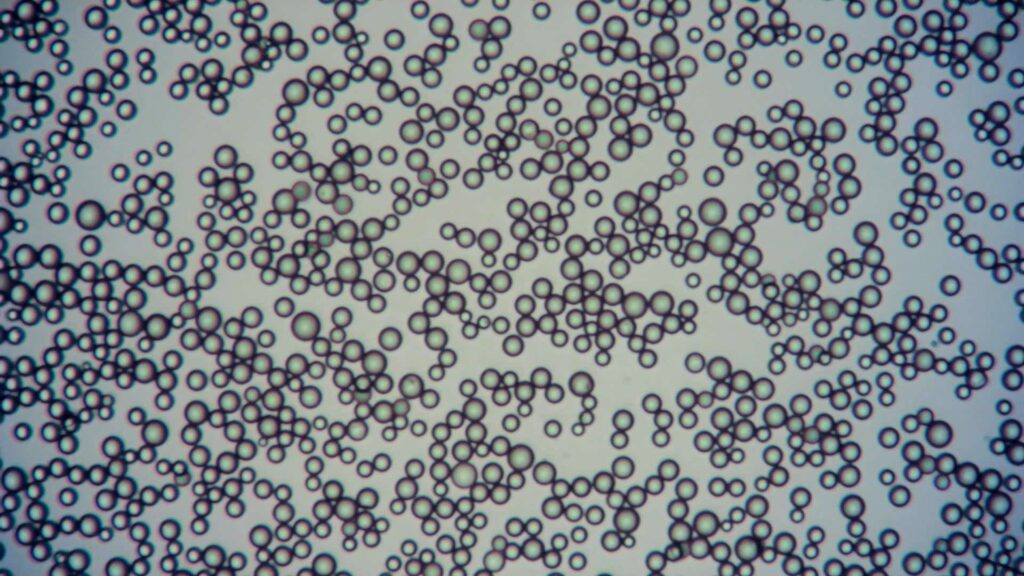
Light microscopic picture: particles in the 10 um size range with a narrow particle size distribution.
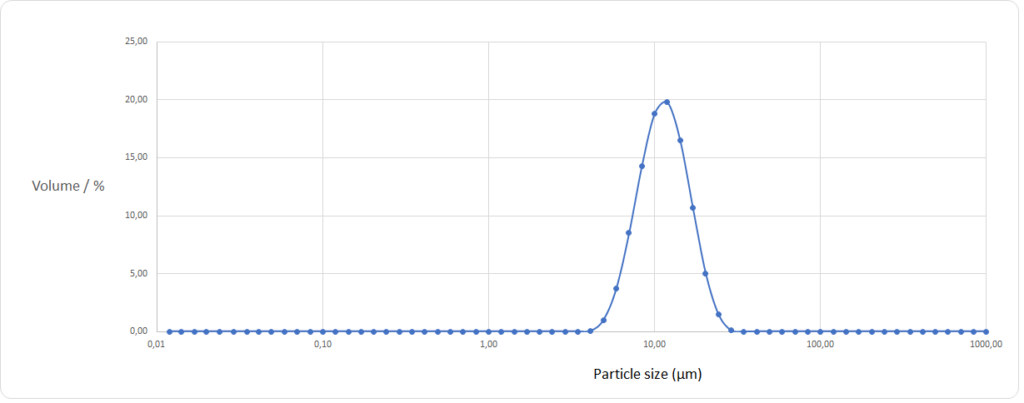
Representative example of a particle size distribution curve of a resin sample.
Resins are supplied as produced. You are responsible for evaluating suitability for your own process. Please read the resin disclaimer before use. Safety data sheets are available on request.
TAILORED RESINS