
Your Innovation Partner for Custom Resins
In a market crowded with generic resin products and extensive academic literature, finding the right tool is only half the battle—retaining access is the other. Many researchers and industrial customers find themselves stranded when critical, useful resins are suddenly discontinued by large manufacturers, leaving their projects without a vital tool.
Redstone Separations is the market leader in filling this gap. We specialize in custom-made resins and “niche innovation” tasks that larger companies avoid because they lack our agility or find the production scale too small. With a high success record across diverse projects, we provide the flexibility and technical expertise needed to solve your most difficult purification and synthesis challenges.
Our Proven Expertise Includes:
- Analytical & Preparative Scale: Successful development of high-performance separation materials tailored to your specific scale requirements.
- Agile Problem Solving: We thrive where others see difficulty, acting as the flexible partner for special tasks that require a boutique, innovation-led approach.
From Concept to Product: Our Proprietary Resin Engineering Process
Redstone Separations utilizes a rigorous, modular development process—from designing the physical morphology to optimizing surface chemistry and functional anchoring groups—to build custom, purpose-built resins for specific applications. The process concludes with tailored particle size calibration, spanning 10 µm to 1200 µm, ensuring that laboratory-developed chemistry translates seamlessly to industrial production.
Our ability to deliver totally new resin chemistries where the market fails begins with a holistic engineering approach. We do not simply modify existing beads; we build your tool from the fundamental structure up. By controlling every layer of development—from the core skeleton to the molecular ‘handshake’—we ensure your resin performs in environments and applications where others cannot. Our process follows a structured path to perfection:
Design of internal resin morphology
- Pore area
- Pore volume
- Pore size
- Rigidity / cross-linking degree
Examples of pore sizes that can be engineered:
- 100 Å (or below) for small molecules
- 300 – 500 Å for peptides and oligomers
- 1000 Å for proteins, antibodies, etc
- >1000 Å for virus, cells, complex biologics
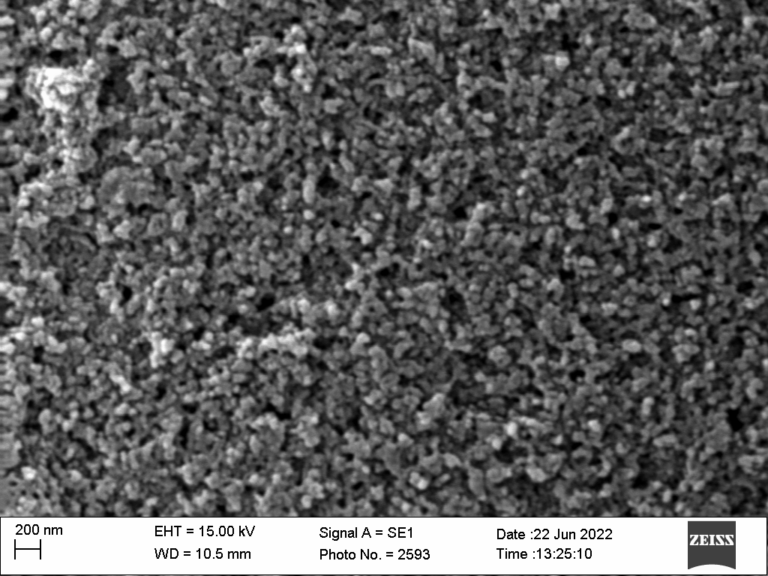
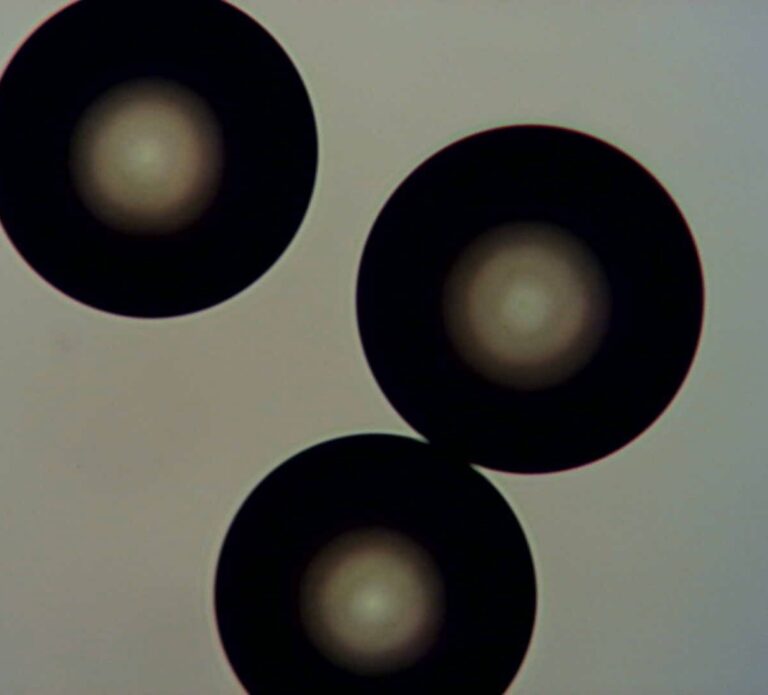
SEM example of large pores. Magnification 50.000 x
Resin surface chemistry
Once the physical structure is established, we “program” the surface. We specialize in creating totally new surface chemistries that go beyond standard ion exchange or affinity groups. In certain cases, the surface chemistry is already built in from the recipe,
- Multifunctional Surfaces: Apart from surfaces with a simple one-type chemistry, we can engineer surfaces with dual-action properties (e.g., hydrophobic and ionic) to handle complex separations in food or pharma.
- Constructed Cavities: For high-selectivity tasks, we design molecularly-tailored cavities that act as “locks” for your specific target molecules.
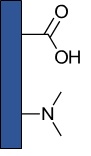
Multi-functional surface
Multi-functional resins display 2 or more distinct chemical surface functionalities. Those exhibit the potential of multi-point surface binding interactions with the desired target molecules. Multi-functional surfaces offer increased selectivity and/or affinity performance towards target molecules.
The chemical groups can be designed and synthesized in discussion with the customer.
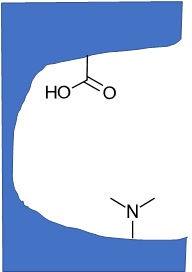
Constructed cavity site
Constructed cavity resins contain accessible binding sites that entail synergistic functional groups that cooperate to bind a target molecule. Cooperative interactions are expected to exhibit a higher selectivity and/or affinity performance towards target molecules.
The chemical groups and their positions can be designed and synthesized in discussion with the customer.
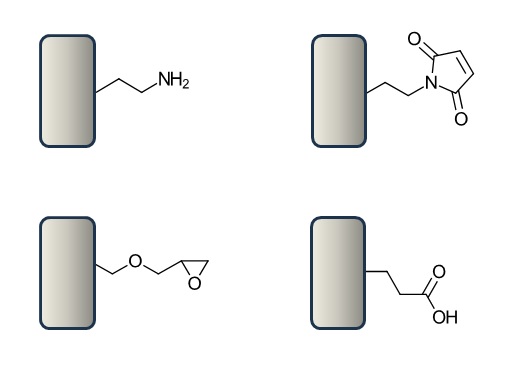
Anchoring groups
The final molecular link is the anchoring group. We offer a library of sophisticated attachment chemistries designed for maximum stability and yield.
- Primary amino groups via glutaraldehye or amide bonds
- Maleimide groups for SH-moeities
- Epoxy groups for amino groups
- Carboxylic acid groups – via acid activation
- Different Linkers can be incorporated
- Other surface chemistries
Particle Size: Precision Engineering from Discovery to Production
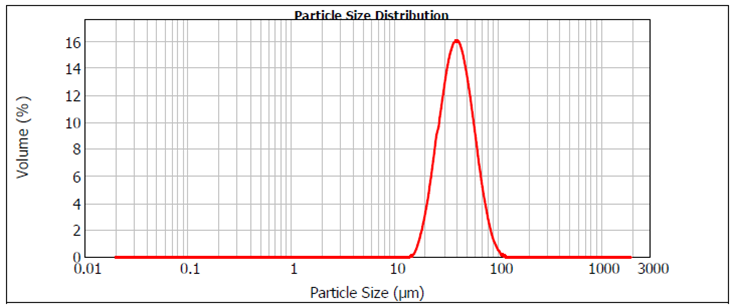
Optimal performance is dependent on the physical dimensions of the resin bead. Whether you are developing an analytical method or a full-scale industrial process, the particle size must be precisely tuned to manage backpressure, diffusion rates, and load capacity.
At Redstone Separations, we offer full control over particle size distribution to match your specific hardware and scale:
- Analytical HPLC: High-resolution separation requires uniform beads in the 10 µm and sub-10 µm range for maximum efficiency in column packing.
- Solid Phase Extraction (SPE): For standardized cartridges and sample prep, we provide materials typically in the 20–90 µm range.
- Solid Phase Peptide Synthesis (SPPS): Our resins for peptide synthesis are optimized for the 75–150 µm range, balancing reaction kinetics with ease of filtration.
- Industrial & Preparative Scale: For large-scale purifications where flow rate and pressure are critical, we supply beads in the prevalent 200–1200 µm range.
Your Scale, Your Specification:
We don’t just offer standard sizes; we manufacture to your exact requirements. Our ability to provide identical resin chemistry across this entire size spectrum ensures a seamless scale-up journey—from initial lab discovery to multi-ton industrial production.
Proven Success: Solving the "Impossible" in Resin Applications
Our track record is built on engineering high-performance solutions where standard market products fail or have been discontinued.
- Supply Chain Security (Resin-Bound Reagents): We developed a high-quality resin-bound reagent to replace competitor’s products that are discontinued due to external supply failures or that are not fit for challenging applications. Unlike others, we manufacture our base beads in-house, ensuring full quality control and a guaranteed, uninterrupted supply for our customers. See in-house example.
- Food Industry (Potato Fruit Juice): We developed a selective resin prototype that significantly reduces polyphenols (see publication) and glyco-alkaloids in industrial side-streams. Project was funded by Vinnova, see link.
- Biotherapeutics (Peptide Separation): To meet the demands of a growing market, we invested in the development of specialized prototypes for the high-resolution separation of therapeutic peptides. View Details.
- Sample Prep (Custom SPE): Leveraging confidential industrial collaborations, we developed proprietary Solid Phase Extraction resins that offer market-leading effectiveness for complex sample preparation. Explore SPE Products.
- Peptide Synthesis (SPPS): We are investing in a new generation of Solid Phase Peptide Synthesis resins to provide the industry with novel high-performance alternatives to traditional supports. See link to academic collaboration.
- Biocatalysis (Next-Gen Enzyme Carriers): Following the discontinuation of key market products, we engineered novel carrier prototypes eg with high hydrophilicity, ensuring minimal substrate binding and exceptional robustness for repeated use. See link for ongoing prototypes.
Steps of tailor-made resin development
Depending on the use of the resin, first simple resins can be evaluated, or more advanced multi-functional resins or highly engineered constructed resins with advance resin architectures can be synthesized and evaluated.
A typical resin development project will go through the standard project phases with defined goals and gates to go to the next phase.

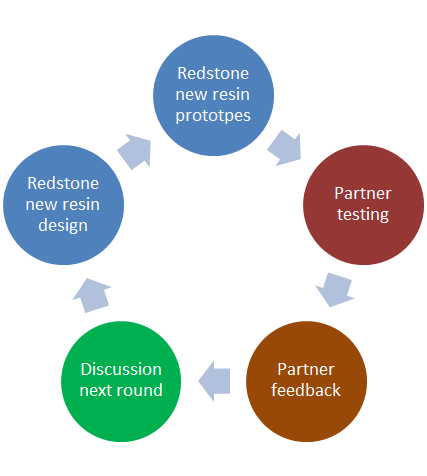
Resin optimization cycle in collaboration with partner / Optimization of hit resin
For a project towards development of a superior resin, a close and interactive collaboration with the partner during the project will ensure a fast evolution of prototype performance.
Projects will be adapted to bring forward novel solid phase synthesis resins, enzyme carriers or resin bound reagent materials.
- In-house library screening for first resin hits / or de-novo synthesis of new resin designs
- Optimization of hit resins for further performance
- Optimization of resin synthesis at lab scale
- Scale-up to pilot scale
- Scale-up of optimized resin to commercial / industrial scale
After resin optimization, Redstone delivers tailor made resin to customer and supports resin testing or implementation at the partner site.
Redstone is an expert resin producer and can provide resins at g, kg and at ton-scale.
Project planning & conduction
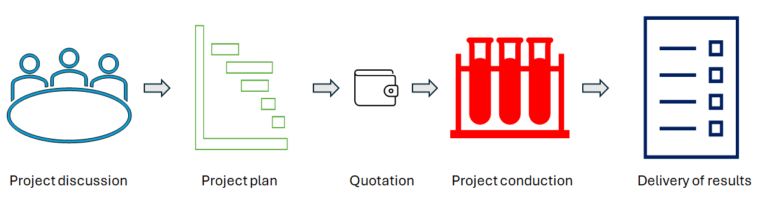
Please contact us for further discussion as this is a case-by-case evaluation.
We will present a project plan and a quote.
Email: info@redstone-sep.com
Phone: +46-738-156-130 (Call times during CET: 8.00 – 18.00)