
Enzyme Carrier Resins
Enzyme carrier resins
Redstone develops and produces novel enzyme carrier (EC) resins for immobilising biological catalysts such as enzymes. Our resin architecture technology allows new material morphologies and chemistries, with improved enzyme immobilisation and easier diffusion of substrate and product.
EC resins are macroporous, with pores large enough to harbour a wide variety of enzymes while allowing starting compounds and products to move in and out freely.
Typical properties:
- Polymeric backbone (hydrophilic, intermediate or hydrophobic), with chemistry that can be adapted
- Chemical functionality for covalently anchoring enzymes, for example amino or epoxy groups
- Pore sizes around 500 Å, 1000 Å or 2000 Å
- Particle sizes 20 to 75 µm, 75 to 200 µm, or larger for faster sedimentation

Schematic of an enzyme immobilised inside a macroporous carrier.
Enzyme carrier material types overview
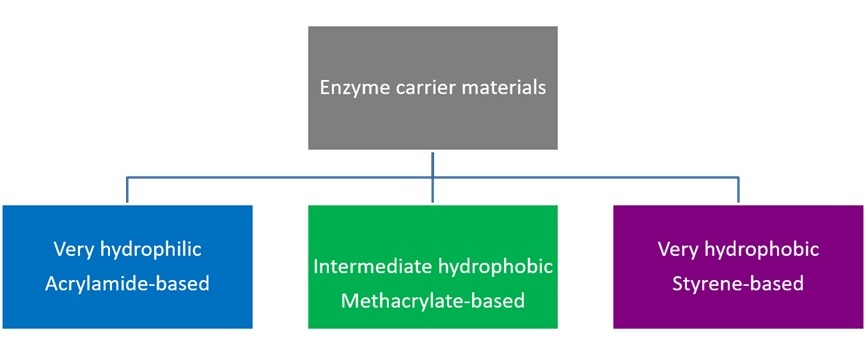
In the hydrophilicity spectrum: very hydrophilic enzyme carriers based on cross-linked polyacrylamides are available; intermediate hydrophilicity resins based on cross-linked methacrylates are available and very hydrophobic resins based on cross-linked polystyrenes.
First results from a hydrophilic carrier
A highly polar and hydrophilic prototype resin is in development, with promising performance in aqueous enzyme supported conversions. As the popular Eupergit C is discontinued, there is a gap in the product offerings, and our cross-linked polyacrylamide variant offers a replacement for such applications.
A highly hydrophobic substrate was first tested for non-specific binding. The Redstone prototype left over 90 per cent of the substrate freely available, while conventional enzyme carriers on the market bound a large portion to their backbone, leaving only around 40 per cent accessible for conversion.
The prototype also showed an enzyme immobilisation efficiency above 85 per cent, and the immobilised construct stayed stable over at least three test rounds with no loss of activity.
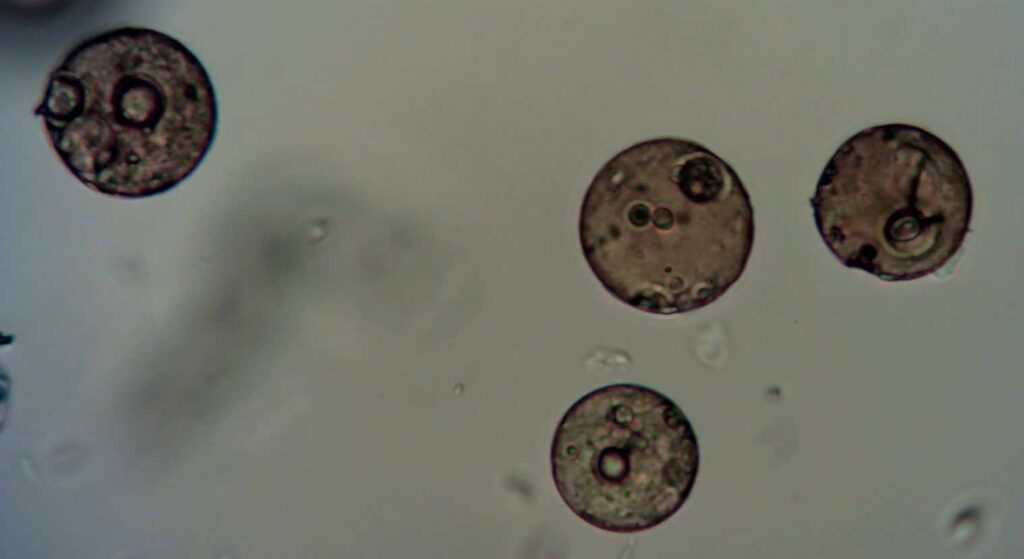
Wet polyacrylamide prototype resin beads, particle size approximately 100 to 300 µm in swollen state.

Non-specific binding of a hydrophobic substrate, compared with conventional carriers.

Enzyme activity over three consecutive conversion runs.
Custom enzyme carriers
A broad variety of EC materials can be designed and supplied, including at industrial scale. See our custom resin development service, or get in touch with an enquiry.
TAILORED RESINS