
TEMIZ™ DVB-SAX MP
Material overview
TEMIZ DVB-SAX MP Resin are polymeric resins based on highly stable DVB-Styrene or intermediate polar methacrylate resins with strong anion exchange (SAX) quaternary amine Chloride groups.
Typical properties of the resins are:
- Porosity: mesoporous – optimal for small molecules
- Cross-linking: moderate cross-linkage
- Particle size: ca 200 – 1200 µm
- Capacity variations: ca 1,4 – 4 mmol/ml (dry resin)
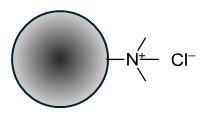
The resins are characterized by its good rigidity and high loading of quaternary amine chloride groups.
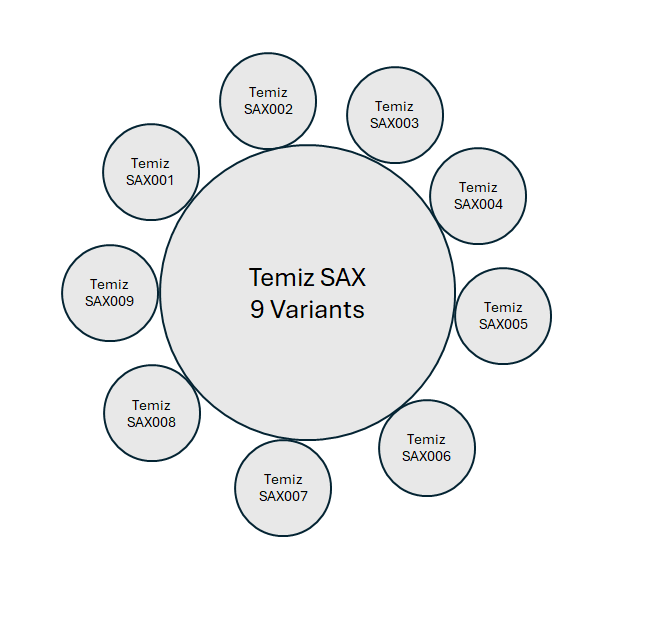
Table of properties of the 9 SAX resin variants in-house.
Resin | Backbone | Capacity dry meq/g |
SAX001 | Styrenic | 2,0 |
SAX002 | Styrenic | 1,9 |
SAX003 | Styrenic | 2,9 |
SAX004 | Acrylic | 1,4 |
SAX005 | Styrenic | 2,2 |
SAX006 | Styrenic | 2,5 |
SAX007 | Styrenic | 4,0 |
SAX008 | Acrylic | 3,0 |
SAX009 | Acrylic | 2,1 |
Some resins have a styrenic backbone and some a acrylic backbone, they differ in capacity and also resin architecture. Those differences can give tremendously different results depending on the application. It is well known that resins with similar basic specifications can behave very differently for a given application. Therefore, it is wise and highly recommended to test a library of promising candidate resins to evaluate for a given separation challenge.
Applications
The strong functional group is effective as a conventional ion exchange resin or scavenger. The relatively small pore size is optimal for small molecules and the resin will exclude large molecules like proteins or other large molecular complexes.
Typical uses for strong anion exchangers are for binding to opposite charged ionic species in various types of solutions including pharmaceutical mixtures or biological extracts or plant-based extracts.
SAX resins can bind and scavenge out the following compound types
- Phenolics
- Organic acids, phosphates
- Inorganic anions
- Biological molecules with acidic groups
One recent example of ours is on the reduction of undesired polyphenolic compounds in industrial potato fruit juice. Interestingly, the best performing resin was SAX002, even though other SAX resins in the collection with similar or higher capacity and with the same styrenic backbone were tested. Hence, resin architecture is an overlooked and important factor in separation science, but must be determined by experimental tests for each matrix. Ie, every complex solution may need to be screened with a library of promising resins to determine the best performing candidate for a given separation challenge.
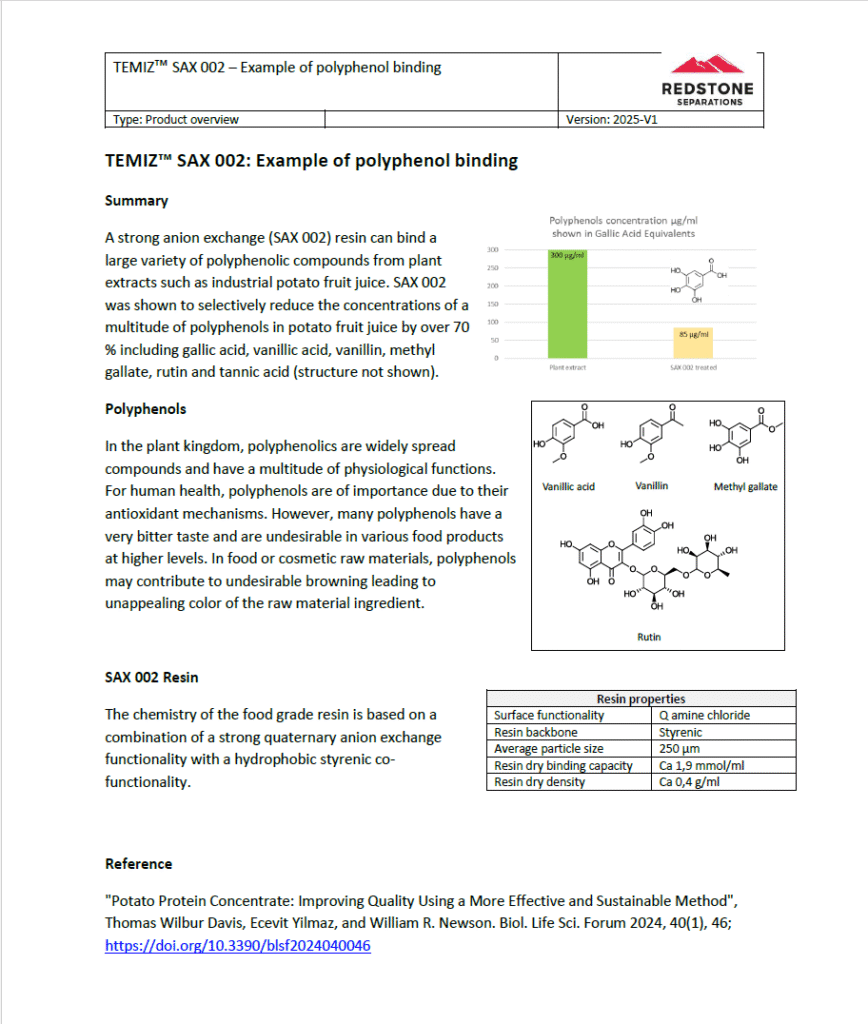
The pdf of the application note can be downloaded here.
The phenolics removal from industrial potato fruit juice and its outcome are published and summarized in open access: “Potato Protein Concentrate: Improving Quality Using a More Effective and Sustainable Method”, Thomas Wilbur Davis, Ecevit Yilmaz, and William R. Newson. Biol. Life Sci. Forum 2024, 40(1), 46; https://doi.org/10.3390/blsf2024040046
Purchase and price list:
Or order directly by email: order@redstone-sep.com
Pls inquire for more information or if you require resin packed in column. For more advantageous pricing of larger quantities and to discuss a quote, please contact us at: info@redstone-sep.com
Phone: +46-738-156-130 (Call times during CET: 8.00 – 18.00)