
SABIT™ DVB-TBD
Material overview
SABIT DVB-TBD is a rigid polymeric resin with surface bound superbase TBD (Triazabicyclo[4.4. 0]dec-5-ene) for use in catalytic reactions or as a novel strong anion exchanger. The resin chemistry backbone consists of highly rigid DVB-Styrene with mesopores and a well accessible surface in essentially all solvents. It constitutes a new polymer-bound catalyst with more robust physical properties than other polymer-supported bases.
With 50 % crosslinking this product is a highly rigid and robust alternative to soft PS-TBD polymer-supported base crosslinked with 1 % DVB, or Triazabicyclodecene–polystyrene crosslinked with 2% DVB.
Table of properties
Property | SABIT DVB-TBD |
Resin backbone | DVB/Sty |
Particle size | 50-200 µm |
Pore volume | 1 ml/g |
Pore area | 600 m2/g |
Av pore size | 80 Å |
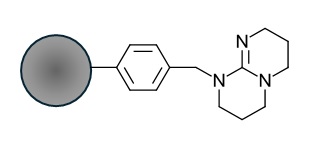
Surface chemistry of SABIT DVB-TBD, with covalently immobilized TBD. Loading ca 1 mmol/g (+/- 0.25 mmol/g).
Swelling behaviour in common solvents.
The resin is highly cross-linked and will only swell moderately or not all, depending on the nature of the solvent.
High swelling solvents are THF, IPA and EtOAc. Whereas DMA leads to virtually no swelling and the solvents at the edge of the spectrum Toluene and water lead to only minor swelling.
Swelling properties
Solvent used | SABIT DVB-TBD ml |
1 g dry resin | 2,4 |
DMA | 2,4 |
Toluene | 2,6 |
Water | 2,6 |
EtOAc | 2,8 |
IPA | 2,8 |
THF | 2,8 |
Application areas
SABIT DVB-TBD can be used to catalyze a number of reactions, such as Wittig reactions, Michael additions, Henry reactions and transesterifications. Resin-bound TBD is easily separated from substrates and product, facilitating the handling and work-up of product. The resin can be used instead of free TBD or TBD bound to soft resins with only 1-2 % DVB – but these low cross-linked resins are not compatible with all solvents and do sometimes not perform well. On the other hand, the morphological rigidity and permanent porosity of SABIT DVB-TBD enable its use in a much wider range of solvents and for certain reaction processes it may be the only tool able to catalyze a desired reaction.
Further, this novel resin-bound base can also be employed as a strong anion exchanger and thus as a scavenger for catch and release processes. As described, its unique structure and good water-wettability allow for effective binding in both polar aqueous and non-aqueous solutions.
Activation and regeneration of SABIT DVB-TBD for re-use
Before and after use, polymer-supported TBD resin may be (re-)activated with a strong base (each time ca 5 ml/g resin):
Step | Organic base regeneration | Water-based regeneration |
Strong base wash | 5% MeONa in MeOH | 1 M NaOH, aqu. |
Removal of base | 3 x MeOH | 5 x water |
Removal of organics | Optionally DCM | 3 x MeOH |
Drying | RT or 70 °C oven | RT or 70 °C oven |
Typical application conditions
- Use 2-10 equivalents of catalyst to limiting reactant
- React for 1 – 20 hours while stirring or shaking
- Reaction at room temperature or to max 90 C
- All common solvents are possible to use
- Resin is easily water-wettable and thus also compatible with aqueous mixtures
- After reaction, filter off resin, or let resin sediment, then decant
- Re-activate resin for re-use following suggested regeneration procedure
Purchase and price list:
Or order directly by email: order@redstone-sep.com
Pls inquire for more information or if you require resin packed in column. For more advantageous pricing of larger quantities and to discuss a quote, please contact us at: info@redstone-sep.com
Phone: +46-738-156-130 (Call times during CET: 8.00 – 18.00)