
SABIT PS-DVB SPPS Resins
SABIT-SPPS Resins are novel resins optimized for solid phase peptide synthesis. All resins are made from scratch in-house, to ensure full control and reproducibility of each synthetic step of manufacturing of the products. It also enables us to provide custom-made variations and tailored solutions to specific peptide sequences.
SABIT PS-DVB AM resins are co-polymers of divinylbenzene and styrene made with proprietary bead formation and novel resin architecture technology. Current variant has aminomethyl functional groups for coupling of a linker prior to peptide synthesis.
Available amino loadings range from 0.2 mmol/g to 1 mmol/g. Higher or lower loadings can be provided upon request.
First SPPS product has 0.75 mmol/g AM and a cross-linking degree of 2 % DVB. Other cross-linking degrees can be provided upon request.
Resin properties
SABIT PS-DVB AM X2-C0.75 Resin Properties
- Resin matrix: DVB/Styrene
- Rigidity (X): Gel-type, 2 % DVB
- Particle size: ca 75-200 µm
- Functionality: Aminomethyl (AM)
- Loading (C): 0.75 mmol/g
- Swelling in DMF: ca 6 ml/g
- Swelling in DCM: ca 8 ml/g
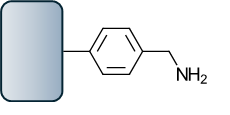
SPPS Procedure making Neurotensin
Performance of SABIT PS-DVB AM X2-C0.75 is exemplified using Neurotensin (13 Amino acids) as a challenging model peptide.
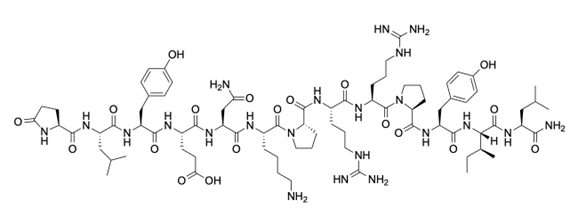
Sabit resin is first modified to Rink amide linker. Standard peptide chemistry (HBTU/HOBt, 1.5 eq.) in DMF, resin amount to synthesize 25 µmol of Neurotensin using each time 1.2 mmol of Fmoc-Amino acid on a Biotage Syro I.
Steps of the synthesis: Swelling –> Rink Amide attachment –> Kaiser test –> Capping –> Fmoc-loading test –> Coupling –> Cleavage –> Prep HPLC –> LC-MS –> Freeze-drying –> LC-MS.
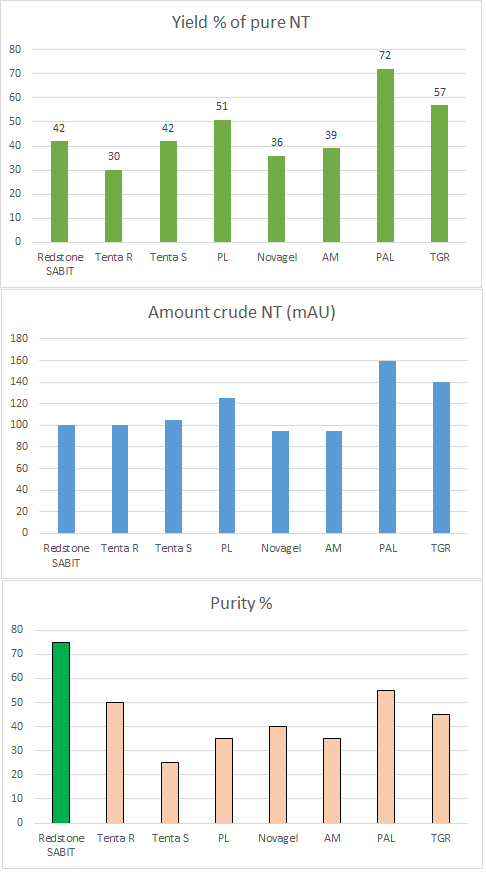
Redstone Sabit PS-DVB AM C2-0.75 resin was compared to 7 commercial resins. Polymer Labs: PL-Rink; Rapp: TentaGel R RAM and TentaGel S RAM; Novabiochem: Fmoc-PAL AM, Rink Amide AM, NovaSyn TGR, Rink Amide NovaGel.
Sabit PS-DVB AM X2-C0.75 had similar levels of crude amount and yields of synthesized Neurotensin as the commercial products. It should be stressed that only Polymer Labs PL-Rink and Novabiochem Rink Amide AM are chemically equivalent to Sabit PS-DVB AM X2-C0.7. The other tested resins have PEG groups in the material backbone. Further, all commercial materials had a cross-linkage of 1 %. All commercial resins had a particle size of around 75-150 µm. Redstone Sabit PS-DVB AM X2-C0.75 has currently cross-linkage of 2 %.
Interestingly, at the last step, the purity was considerably higher for the SABIT resins compared to the tested commercial benchmark products.
The above first results suggest that these novel SPPS resins developed by Redstone Separations are promising and well performing resins for solid phase peptide synthesis. Preliminary tests also showed that Sabit PS-DVB AM X2-C0.75 resins are working well with larger peptides such as GLP-1 variants and more detailed results in the product link.
The evaluation of the resins was conducted at Lund University, Sweden (see master thesis link) under the supervision of Prof. Knud Jensen, Copenhagen University, Denmark (Link).
Abstract
Solid-phase peptide synthesis (SPPS) is the most widely used method for producing synthetic peptides, with the solid support-known as the resin-being a critical component of the process. Redstone Separations AB, a company based in Lomma, Sweden, has developed new SPPS resins and aims to evaluate their performance compared to commercially available alternatives.
In this study, Redstone ́s resins were assessed by synthesizing three peptides: Neurotensin, GLP-1 (at both room temperature and elevated temperature), and an RGD-peptide. These peptides were synthesized using SPPS followed by post-synthetic modifications for the RGD peptide, and resulting products were evaluated for yield and purity.
The results showed that for Neurotensin, some Redstone ́s resins outperformed some commercial resins, although the highest performance was still observed with the commercial resins. In the synthesis of GLP-1, both at room and elevated temperatures, commercial resins yielded better results, but Redstone ́s resins were comparable. The synthesis of the RGD-peptide was unsuccessful for both Redstone and commercial resins, as the obtained amounts were too low to quantify and the right peptide was not seen for some of the resins.
Overall, the results demonstrate that Redstone ́s resins are capable of producing peptides in reasonable yields and purities. Although further optimization is needed to reach or surpass the performance of established commercial resins, these findings are promising, especially considering that Redstone is newly established maker of SPPS resins in the market and that it was shown that the resins worked for SPPS overall
Purchase and price list:
Or order directly by email: order@redstone-sep.com
Pls inquire for more information or if you require resin packed in column. For more advantageous pricing of larger quantities and to discuss a quote, please contact us at: info@redstone-sep.com
Phone: +46-738-156-130 (Call times during CET: 8.00 – 18.00)
Tailor-made resins
Redstone Separations AB offers tailor-made resins that can be adapted to eg specific peptide sequences to optimize production economics – as each peptide may require an optimal resin for production. Adaptations can be on: cross-linkage, loading, back-bone chemistry, resin architecture, particle size or type of Linker.
We can provide novel resins with a fast turn-around time. Please read more here: