
SABIT™ DVB-TBD Catalysis example
Application areas
TBD is a bicyclic guanidine base and is one of the so-called superbases with a pKa value of 25. We provide TBD covalently immobilized on an optimized porous polymeric resin for facilitated catalysis, where the resin-bound catalyst can be easily removed from the reaction mixture avoiding cumbersome chromatographic or other purification steps.
SABIT DVB-TBD can be used to catalyze a number of reactions, such as Wittig reactions, Michael additions, Henry reactions and transesterifications. Resin-bound TBD is easily separated from substrates and product, facilitating the handling and work-up of product. The resin can be used instead of free TBD or TBD bound to soft resins with only 1-2 % DVB – but these low cross-linked resins are not compatible with all solvents and do sometimes not perform well for certain reactions.
On the other hand, the morphological rigidity and permanent porosity of SABIT DVB-TBD enables its use in a much wider range of solvents. For certain reaction processes and solvent it may be the only tool available to catalyze a desired reaction.
Further, this novel resin-bound base can also be employed as a strong anion exchanger and thus as a scavenger for for negatively charged compounds for catch and release processes. Its unique structure and high surface loading of TBD groups renders it water-wettable and this allows for effective binding in both polar or aqueous solutions and non-aqueous solvents.
Expert evaluation of SABIT DVB-TBD
The group of Prof. Christian Marcus Pedersen at Copenhagen university conducted the first evaluation of catalysis using this novel resin-supported superbase with outcomes of practical utility to the organic chemistry community. Sabit DVB-TBD is thus an additional tool for organic chemists. With it rigid resin structure at ca 50 % cross-linking it is usable in many more solvents than soft resin-bound superbase products with less than 1 % or 2 % DVB cross-linkage (from Merck or Biotage). The high cross-linkage ensures bead stability and open pores under almost any common solvent environment.
Activation and regeneration of SABIT DVB-TBD for re-use
Before and after use, polymer-supported TBD resin may be (re-)activated with a strong base. Use each time ca 5 ml/g resin of the given solution to the resin. Let interact for a short while (few minutes) while shaking or stirring, then filter off or decant resin for next step.
Step | Organic base regeneration | Water-based regeneration |
Strong base wash | 5% MeONa in MeOH | 1 M NaOH, aqu. |
Removal of base | 3 x MeOH | 5 x water |
Removal of organics | Optionally DCM | 3 x MeOH |
Drying | RT or 70 °C oven | RT or 70 °C oven |
Typical application conditions
- Use 2-10 equivalents of catalyst to limiting reactant
- React for 1 – 20 hours while stirring or shaking
- Reaction at room temperature or to max 90 C
- All common solvents are possible to use
- Resin is easily water-wettable and thus also directly compatible with aqueous mixtures
- After reaction, filter off resin, or let resin sediment, then decant
- Re-activate resin for re-use following above suggested regeneration procedure
Representative procedure: catalysis of a reaction
The first model reaction shown is the reaction of an alcohol with trichloroacetonitrile to a trichloroacetimidate. These results were developed by Prof. Christian Pedersen, Copenhagen University, Dept. Chemistry.
Acetimidates are commonly synthesized and used as intermediates for heterocycle synthesis or as reagents for alkylation reactions
Approximately 5 equivalents of DBV-TBD base are used with respect to alcohol and reacted for 1 hour at room temperature in a green, non-toxic (food-grade) solvent, propyl-acetate. Yield is ca 75 %. Higher yields may be obtained with longer reaction times and higher temperatures.
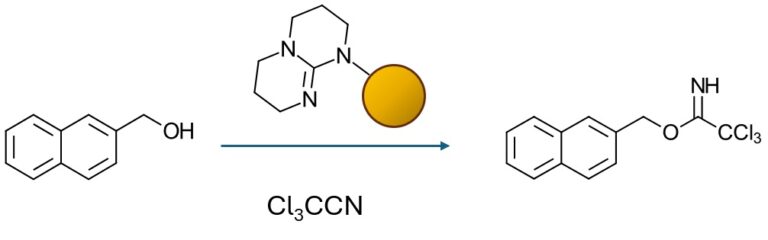
Sabit DVB-TBD efficiently catalyzed the reaction in different solvents and also green solvents like n-propyl acetate worked better than the reaction catalyzed by conventional PS-DBU.
The results are published in 2026 in Chemistry Methods and is open access. Pls contact Prof. Pedersen at Copenhagen University for more details on his work.
Purchase and price list:
Or order directly by email: order@redstone-sep.com
Pls inquire for more information or if you require resin packed in column. For more advantageous pricing of larger quantities and to discuss a quote, please contact us at: info@redstone-sep.com
Phone: +46-738-156-130 (Call times during CET: 8.00 – 18.00)