
Amino resin collection
Amino resins are actually quite versatile tools in life sciences.
Here we present the possibilities that amino resins offer for screening tests, assay development, solid phase synthesis and chromatography.
Due to its versatility, amino groups are popular anchor groups on solid phases for immobilization of compounds.
For screening work, amino resins offer the possbility to covalently immobilize different ligands with carboxylic acid groups on the resin for subsequent binding studies.
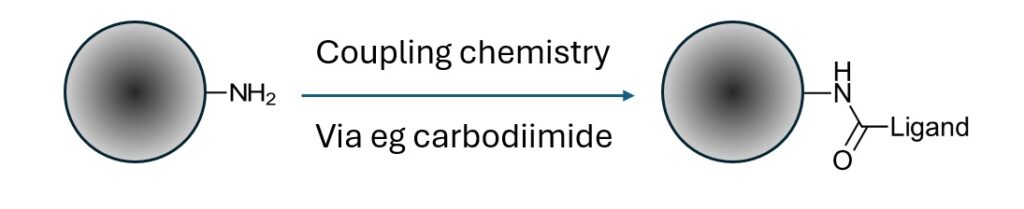
There are a multitude of coupling chemistries and using carbodiimides, such as DIC (Di-isopropyl-carbodiimide) in dry solvents to immobilized carboxylic acid-containing ligands is a widespread and proven route to covalent coupling under organic conditions.
In aqueous systems, glutaraldehyde are popular coupling reagents to immobilize water soluble compounds via their amino group to the amino functionality on the resin. More coupling techniques can be found by simple searches.
Redstone Separations has a variety of resin rigidities that can be evaluated for different studies. The resins that are currently available are DVB/Styrene based with aminomethyl surface functionalities.

The advantage that is offered here is that we have range of rigidities ranging from high swelling of Sabit DVB/Sty AM X2 (eg 8 ml/g) to low swelling of Temiz Polar RR Amino (eg less than 20 % compared to dry state).
The high swelling resins offer potential for easy access in the right type of solvent where the resin swells. However, in some solvents, the low cross-linked DVB/Sty does not swell but collapses – which then means no functional groups are accessible any more, thus no capacity and therefore no binding.
On the othe hand, the low-swelling resins have a permanent porosity and the amino groups are well accessible in virtually any solvent. There is no risk of resin collapse due to high cross-linkage and rigidity of the resin. Another advantage is that rigid resins can be employed in flow systems as they remain intact und flow and pressure. A disadvantage could be slower diffusion and access to the active sites – however, this can be alleviated with the design of larger pores. But larger pores lead to lower surface area and thus lower capacity.
As always, there are pros and cons and the actual application and project challenge will reveal which base resin gives the best outcome.
The above resins cover hydrophobic base resins based on cross-linked polystyrene, surface modified to benzylamine groups. Other base resin chemistries will be made available, such as very hydrophilic materials based on cross-linked polyacrylamide variants.
Contact us for further details on other resin rigidities or properties: info@redstone-sep.com