
SABIT PDMA SPPS Resins - preview
SABIT-SPPS Resins are novel polymer supports optimized specifically for solid-phase peptide synthesis (SPPS). Developed and manufactured entirely from scratch at our facilities in Lund, Sweden, we maintain total control over production quality and reproducibility at every scale. This complete manufacturing oversight also allows us to deliver custom-made variations tailored to your specific peptide sequences.
By mimicking the peptide backbone through abundant amide bonds, the polymeric dimethylacrylamide backbone interacts unhindered with highly polar solvents like DMF, DMA, and NMP. This creates a strongly solvated, peptide-like environment designed to effectively prevent peptide aggregation.
With a well controllable amino loading of 0.5 mmol/g, SABIT PDMA resins offer unparalleled predictability for preparative SPPS process economics. Accurate loading allows users to precisely dose expensive amino acid building blocks, coupling agents, and solvents. This optimization directly improves cost efficiency, environmental sustainability, and workplace safety across the peptide industry.
This product class serves as an excellent alternative to discontinued ChemMatrix or PEGA resins. It also stands as a powerful alternative to traditional hydrophilic and composite resins, such as TentaGel, which rely on cross-linked polystyrene backbones with grafted PEG constructs.
Sabit PDMA AE LR-C0.5 Prototype Resin Parameters
collected data of current PDMA variant
SABIT PDMA AE LR-C0.5 prototype | |
Resin matrix | Poly-dimethylacrylamide |
Particle size | Ca 75-300 µm |
Functionality | Aminoethyl AE |
Loading (C) | 0.5 mmol/g |
Swelling in DMF | Ca 7-8 ml/g |
Swelling in Water | Ca 8-12 ml/g |
Swelling in IPA | Ca 7-8 ml/g |
A short how to use instruction document can be found here. It describes the steps from receiving the resin salt to free base conversion in an organic solvent.
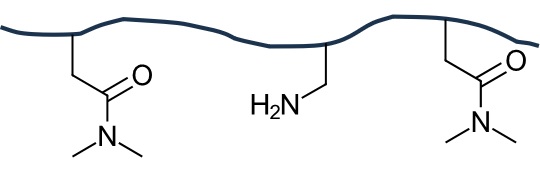
Schematic chemical polymer resin structure of PDMA beads consisting of a poly-dimethylacrylamide chain with pendant amino-ethyl groups.
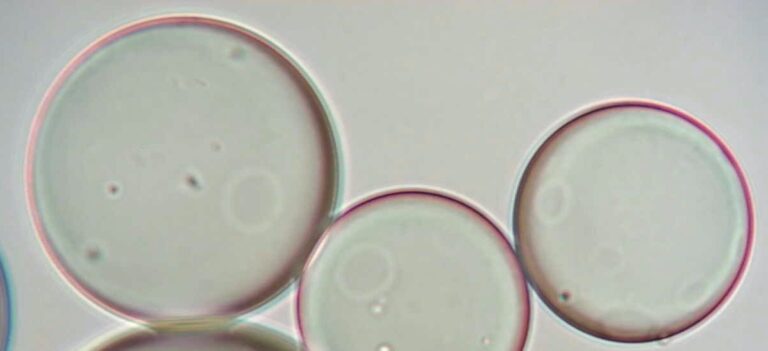
Light microscopic picture of wetted PDMA resin (75 -200 µm).
- Aromatic-Free Hydrophilic Matrix: Features a fully hydrophilic, amide-based chemical architecture completely free of aromatic components. This polar environment is engineered to minimize peptide aggregation and eliminate the steric hindrances common during sequence elongation.
- Enhanced Structural Integrity: Unlike legacy PDMA variants which were notoriously gel-like, highly compressible, and prone to bead breakage under pressure, our novel resin architecture provides exceptional mechanical strength. The durable beads withstand packing into HPLC columns, yield remarkably low backpressure, and remain intact after prolonged runs—making them ideal for large-scale continuous flow systems.
- Optimized Large-Pore Network: Engineered with a large pore structure verified via Size Exclusion Chromatography (SEC). The spacious architecture ensures excellent mass transfer and diffusion, demonstrated by the high retention and accessibility of large peptides like insulin.
- Predictable Process Economics: Amino loading levels are highly controllable and verified via quantitative titration of free amino groups. This precise loading enables exact dosing of Fmoc-amino acids, coupling agents, and expensive building blocks, maximizing cost control while significantly reducing chemical consumption and hazardous waste.
- Rapid Coupling Kinetics: Offers incredibly fast reaction kinetics due to the open, accessible polymer network. In application trials, pre-activated symmetrical anhydrides (5 eq.) dissolved in NMP/TEA achieved complete coupling within minutes, confirmed by a negative Kaiser test.
- Versatile Biocompatible Applications: Excellent potential for on-resin biochemical assays with immobilized ligands, direct enzymatic screenings, combinatorial library synthesis, or deployment as an affinity stationary phase in chromatography.
- Scalable Commercial Supply: Supported by an efficient production process capable of handling substantial volumes. Prototype and pilot quantities can be purchased in kilogram scales with short lead times; for ton-scale production inquiries, please contact our team directly.
- Adjustable Swelling & Rigidity: Custom-tuned cross-linking densities to achieve the exact swelling behavior and mechanical rigidity required for your specific solvent systems.
- Controlled Loading Variations: Precision manufacturing of higher or lower functional group substitution levels (mmol/g) to optimize local peptide concentrations and minimize interchain aggregation.
- Optimized Particle Sizes: Narrow, smaller particle size distributions explicitly engineered to maximize packing efficiency and maintain low backpressure in high-pressure column or continuous-flow processes.
- Pre-Loaded Linkers: Integration of specific linkers to seamlessly accommodate different peptide C-terminal requirements.
- Alternative Surface Functionalities: Custom functional group modifications tailored to align with unique coupling chemistries or downstream applications.
- Collaborative R&D: Bespoke synthesis driven entirely by user-defined specifications, structural inputs, and process constraints.
Early Access Program: Secure Your Prototype Batches
Pls inquire for more information or if you require resin packed in column. For more advantageous pricing of larger quantities and to discuss a quote, please contact us at: info@redstone-sep.com
Phone: +46-738-156-130 (Call times during CET: 8.00 – 18.00)