
SABIT PDMA SPPS Resins - preview
SABIT-SPPS Resins are novel resins optimized for solid phase peptide synthesis. All resins are made from scratch in our labs and production facilities in Lund, Sweden. This ensures full control and reproducibility of each synthetic step or scale of manufacturing of the products. It also enables us to provide custom-made variations and tailored solutions to specific peptide sequences.
SABIT PDMA resins are fully hydrophilic resin beads and are co-polymers of dimethylacrylamide made with proprietary bead formation and novel resin architecture technology. Current variant has aminoeethyl functional groups for coupling of a linker prior to peptide synthesis. An polymeric dimethylacrylamide backbone mimics the peptide backbone with its abundant amide bonds, it interacts excellently with highly polar solvents such as DMF, DMA and NMP. It is expected to effectively prevent peptide aggregation by creating a strongly solvated, peptide-like environment.
Current amino loading is at 0,5 mmol/g and is well controllable and predictible, which gives the user the potential for better predictablity in production economy in preparative solid phase peptide synthesis. An accurate loading level allows the user to properly dose expensive amino acid building blocks, coupling agents and solvents at the most economic level. This contributes to improved economics, environmental sustainability and work safety in the peptide industry.
This product class is believed to be a possible alternative to discontinued ChemMatrix or PEGA resins. Also, it may be considered a potential alternative to other hydrophilic resins such as Tentagels or other composite resins that consist of cross-linked polystyrene backbone with grafted PEG constructs.
An often observed adverse peptide synthesis such as aggregations or other phenomena may be diminished with fully hydrophilic resin environments of the growing peptide chain. Hence, an aim is to improve the yield and purity of long, complex, and hydrophobic (“difficult”) peptides. With a resin environment that essentially matches dimethylacetamide or dimethylformamide it may overcome the physical and chemical limitations inherent to traditional polystyrene (PS)-based resins. As a peptide chain grows, it tends to fold into secondary structures (eg beta-sheets) and aggregate. The hydrophilic networks of PDMA-based matrices are expected to repel the growing peptide backbone, keeping it extended and accessible for successive amino acid couplings.
Sabit PDMA AE LR-C0.5 Prototype Resin Parameters
collected data of current PDMA variant
SABIT PDMA AE LR-C0.5 prototype | |
Resin matrix | Poly-dimethylacrylamide |
Particle size | Ca 75-300 µm |
Functionality | Aminoethyl AE |
Loading (C) | 0.5 mmol/g |
Swelling in DMF | Ca 8 ml/g |
Swelling in Water | Ca 8 ml/g |
Swelling in IPA | Ca 8 ml/g |
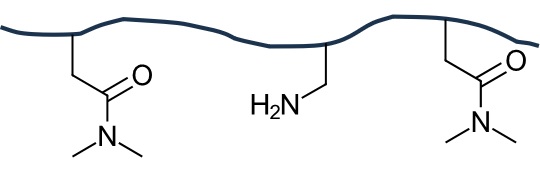
Schematic chemical polymer resin structure of PDMA beads consisting of a poly-dimethylacrylamide chain with pendant amino-ethyl groups.
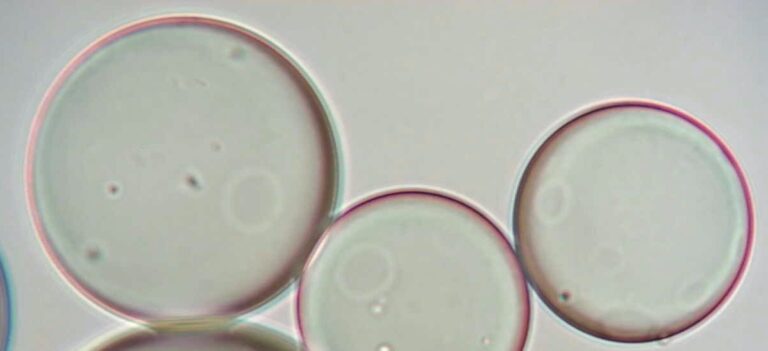
Light microscopic picture of wetted PDMA resin (75 -200 µm).
SABIT PDMA AE LR-C0.5 Resin Prototype Properties and Expected Advantages
- Fully hydrophilic, amide based resin chemistry, without any aromatic resin components. Very low aggregation and other adverse growing peptide constructional limitations expected.
- High resin integrity, can be packed into HPLC columns, gives very low backpressure and beads are intact after long runs. Expected to be useful in flow systems with appreciable column size and flow-rates.
- Previously published PDMA variants were gel-like, highly compressible, prone to collapsing under pressure and ultimately very fragile with a high propensity for breakage of beads. Our novel resin technology brings forward a stronger resin integrity for this material class.
- Large pores in the material determined by Size Exclusion Chromatography where large peptides such as insulin has good retention.
- Controllable and predictable amino loading levels, confirmed by titration of the free amino groups – enabling the user of precise dosing of Fmoc-amino acids, coupling agents and other expensive building blocks. This allows for better control of economic parameters in peptide synthesis potentially leading to large reductions in chemicals and toxic waste.
- Fast reaction of amino groups with activated acids (few minutes until completion). In our experiments: anhydride (5 x) dissolved in NMP/TEA reacts within minutes with all amino groups on resin, confirmed by negative Kaiser test. This confirms free and speedy accessibility to the amino groups in the spacious polymer architecture.
- Expected to be employable for on-resin assays with ligands immobilized on the functional groups on the resin.
- Economic production allows for supply of large amounts or resin.
Tailor-made resins
Redstone Separations AB offers tailor-made resins that can be adapted to eg specific peptide sequences to optimize production economics – as each peptide may require an optimal resin for production.
- Other rigidity and swelling properties
- Higher or lower loading with good control can be provided
- Smaller particle sizes for high pressure column processes
- With a linker for various peptide terminal groups
- Other surface functional groups
- Any other input from the end-user
- For custom-made developments, pls inquire at info@redstone-sep.com.
Purchase and price list:
Or order directly by email: order@redstone-sep.com
Pls inquire for more information or if you require resin packed in column. For more advantageous pricing of larger quantities and to discuss a quote, please contact us at: info@redstone-sep.com
Phone: +46-738-156-130 (Call times during CET: 8.00 – 18.00)